
The BBC’s
Ghost Story for Christmas series originally extended from 1971 to 1978. Highly esteemed by supernatural fiction enthusiasts, it is mainly remembered for its adaptations of classic tales by M.R. James, although 1976’s atmospheric version of Dickens’
The Signalman is often considered to be the finest. In recent years, attempts have been made to revive the series, with new productions of James’s
A View from a Hill and
Number 13 appearing in 2005 and 2006. Whilst these are enjoyable exercises in television nostalgia, there is an air of pastiche about them which means that they fall short of the original series’ level of excellence.
This year it was revealed that the
Ghost Story for Christmas was to be a remake of
Whistle and I’ll Come to You. Although Jonathan Miller’s 1968 Omnibus production of this pre-dated the series proper, it has joined it in popular memory as the first and most impressive of the BBC’s M.R. James adaptations. It is an extraordinary work that succeeds on many levels, and is a hard act to follow. I was thus mystified as to why the BBC should have chosen
Whistle and I’ll Come to You rather than one of the many other tales by M.R. James and his Victorian and Edwardian contemporaries that have not yet been filmed.
Memories of pointless remakes such as
The Haunting and
The Wicker Man started to rise unbidden, provoking fears that were hardly laid to rest by an announcement that the remake was to be “a contemporary update, influenced by Japanese horror films and
The Shining”, penned by Neil Cross. Oh dear. One bit of good news was that the star was to be John Hurt, surely an actor with sufficient gravitas to pull the pull the project through.
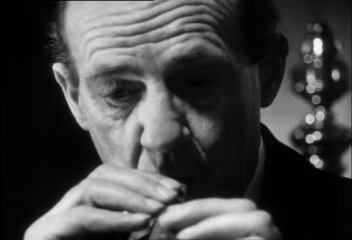
The issue of faithfulness to the original story is a complex one. Television and the written word and two separate media, and what works on the page is not necessarily going to be what’s best for the small screen. Jonathan Miller certainly didn’t take the path of slavish adaptation. However, although he was not afraid to make changes to the original, particularly in the area of characterization, he certainly took no liberties. His re-imagining of the story’s protagonist, Professor Parkin, as a bumbling old absent-minded don, played to perfection by Michael Hordern, was a stroke of genius.
Horden’s portrayal is a pleasure to watch in every frame. Here is a man fully at

home with his own company and absorbed in his own mental processes to the extent that he has become somewhat disengaged with the rest of the world. As we observe his break at a desolate East Coast seaside resort, we become fully acquainted with the man and his habits. An amusing exchange with another hotel resident in which he applies linguistic logic to dismiss the notion of ghosts shows up Professor Parkin’s one big flaw; he is pleased to the point of smugness with his own arguments and formulations. In particular, he is delighted by his inversion of a famous quote from Hamlet: “There are more things in philosophy than are dreamt of in Heaven or Earth”.
Parkin’s faith in his academic superiority is threatened by the unaccountable events that take place after he discovers and blows and old whistle he discovers in an ancient cliff-top graveyard. Miller remains true to the story’s suggestion that the “ghost”, when it eventually appears, would not have had the power to physically harm its victim. The fear is not of violence or gore, but something far more powerful; the ease with which a logically constructed world-view established over decades of study and argument can be brought crashing down by a single anomalous experience. Jonathan Miller (no believer in the supernatural himself) has turned James’ comic-horrific tale of a conceited young don into a full-blown parable on intellectual hubris.
With this illustrious predecessor in mind, it was with some trepidation that I switched on the TV to view Neil Cross’s “contemporary retelling”. First impressions were not good; we are thrown head first into a scene not bearing the remotest resemblance to anything in the original story. The elderly Parkin (John Hurt) has been saddled by the screenwriter with a senile wife (Gemma Jones) and is shown depositing her into what can only be described as the care home from hell. Parkin (who we learn is a retired astronomer) appears to be a wealthy man, so why he has chosen to place his beloved spouse in this grim establishment, in which the inmates are sat in rows in high-backe

d chairs wearing identical white gowns, is not explained. To a critical viewer, however, the answer is obvious. This is not one of the quaintly observed social locales we might expect as a background to the chilling goings-on in a
Ghost Story for Christmas; this is Generic Horror-Land. And thereby hangs the weakness of this production. James’ finely crafted tale has been hollowed out and used as the vehicle for another, different story entirely; a markedly inferior one. You wonder how this came about; presumably the piece needed the cachet of the original to reach production and attract a talent of John Hurt’s calibre. Surely, however, it can only suffer from comparison with the original?
John Hurt has, it must be said, a most impressive face. Deeply creased and furrowed, it ages him beyond his seventy years. He is made to star in a Samuel Beckett biopic and somebody should really get to work on this immediately. In
Whistle and I’ll Come to You, however, the poor man is coasting. He has one direction, which is to look miserable, and he does this exceedingly well. Yet everything about this work is lifeless and depressing, with fifty-two minutes of it stretching out interminably.
Having left the catatonic wife at the Stephen King care home, in the hands of the patronising nurse who is on single-handed duty there, Parkin (in a rare piece of faithfulness-to-the-plot) makes his way to a seaside hotel. This establishment is equally short-staffed and, apart from one family, which packs up and leaves during his stay, Parkin is the sole resident. Jonathan Miller showed us exactly how Professor Parkin spends his solitary days by the seaside, conveying a fine sense of life of the hotel and the nature of his solitary rambling. By contrast, the 2010 version seems fractured and drawn out. The setting has been transferred for some reason from East Anglia to Thanet in Kent, so we are presented with chalk cliffs in place of flat sands and, most importantly, no groynes to act as hurdles in the ghostly pursuit along the beach. Continuity is poor, however, and we never get a clear idea of the landscape and how it stands in relation to the hotel. Cliffs appear first in one direction and then in another. We are never sure how far Parkin has walked or what time of day it is.
The two big scares are stolen from elsewhere. First of all, there is a fearsome, u

nexplained banging on the bedroom door while Parkin is trying to sleep. This scene is reminiscent of Robert Wise’s
The Haunting, but that is rather a classy reference for this production. The pre-screening publicity suggests that this scene was intended to evoke memories of axe-wielding Jack Nicholson from
The Shining. Unfortunately as Parkin cowers beneath the postcodes, the response is more likely to be “Why doesn’t he just open the bloody door?”
Scare no.2 (which sinks any pretence at subtlety the production may have had until now) is lifted direct from 1998 Japanese horror smash
Ringu. Just like Sadako’s stylised ghost crawling from a TV screen, the wraith of Parkins’ senile wife crawls beneath the three-inch gap conveniently left for her beneath his bedroom door. Crawling up the bed, she screams manically “I’m here, I’m here!” into his startled face – a disruption which causes the poor old codger to expire on the spot. Given the idyllic loving relationship that we have been led to believe existed between the two, this occurrence is somewhat surprising. Is it supposed to be a manifestation of the mood changes medically associated with Alzheimer’s disease? Parkin has earlier expressed to the hotel manager his horror at witnessing his wife’s living body minus her personality. Presumably the idea is that, by appearing in the guise of a Japanese ghost, Mrs. Parkin is merely attempting to alert her husband to her continued existence. But wouldn’t a gentler, more loving reminder have sufficed? There is no law stating that ghost stories

have to be about crude horror. This story could have concluded in a heartwarming manner, offering consolation to individuals and families afflicted by dementia.
The final scene contributes more confusion, leading many viewers on online forums to question what happened. The nurse at the rest home (yes, that nurse) glimpses Mrs. Parkin among the white-gowned upright-chair-sitters before glancing back to see she has disappeared, a fact she acknowledges with a wry grin. Obviously she has died and become a ghost, but why she appears in such a peaceful form to the nurse (who seems quite unfazed) after scaring her poor husband literally to death is a mystery, only explained by the reflection that this is just a clichéd conclusion to a generic plot.
The plot of M.R. James’s masterpiece has been mutilated to a ridiculous extent. Most bizarrely, some bright spark has decided
not to have a whistle, rendering the title entirely meaningless. The only reference to one when Parkin sings the Burns song into his wife’s ear near the beginning, but the relevance of this is not explained and most viewers will probably have missed this anyway. Removing this key plot element has the sole effect of making the thing even more tedious and uneventful – the director clearly thinking that picture postcard views of the seaside are sufficient to retain our attention.
One of M.R. James’ strengths is the inexplicable nature of his apparitions. All that is known about the ghost (if that’s what it is) in Oh, whistle and I’ll come to you is that it is comes from far away and is connected to the Knights Templars, a mediaeval religious order associated with diabolism and forbidden practices. An air of antiquity and the arcane pervades his tales, infecting the cosy world of his protagonists with the miasma of ancient wrongs. By contrast, the 2010 BBC production adheres to modern Hollywood conventions. In a quote from 1999’s CGI-ridden version of
The Haunting (the direst remake of all), “It’s all about family!” In other words, the Supernatural must play second fiddle to a tedious soap opera plot that attempts to put a “psychological” spin on everything that happens to make it “relevant to a modern audience”.
All in all, this was a tragically wasted opportunity. The ingredients for a top

-quality production were there in terms of casting and cinematography, but it foundered on the rocks of a dumbed-down screenplay. Considering the rich tradition of British horror, it is difficult to see the relevance of referencing works such as
Ringu. Presumably the intention was to be “with it” and fashionable, but the Japanese horror craze was ages ago now, probably when the people who produced this were still at university. This demonstrates the weakness of the whole thing; it was made by people with no sensitivity or feel for their source material, who clearly felt they could improve on the original. Given the story’s warning against hubris, this is ironic to the extreme.


 The Witches (1966)
is one of Hammer’s lesser-known productions.
Lacking the Gothic trappings most commonly associated with the studio’s
horror output, it was designed as a star vehicle for Joan Fontaine (an Oscar-winner for her performance in Hitchcock's Rebecca over a quarter of a century earlier), who had acquired the
rights to film a novel called The Devil’s
Own by Peter Curtis, a pseudonym employed by bestselling historical
novelist Norah Lofts.
The Witches (1966)
is one of Hammer’s lesser-known productions.
Lacking the Gothic trappings most commonly associated with the studio’s
horror output, it was designed as a star vehicle for Joan Fontaine (an Oscar-winner for her performance in Hitchcock's Rebecca over a quarter of a century earlier), who had acquired the
rights to film a novel called The Devil’s
Own by Peter Curtis, a pseudonym employed by bestselling historical
novelist Norah Lofts.  The Devil’s Own has
been reissued in paperback as The Witches by the renascent Hammer, as part of
a series of movie tie-ins and novelisations (it has also previously appeared as
The Little Wax Doll under Norah Lofts’
own name). Unfortunately, Hammer has chosen
to saddle the book with an embarrassing generic cover which bears no relationship to its contents and is evidently designed to mislead fans of Twilight and similar 'young adult' sagas. Anyone seeking ‘supernatural romance’ in The Witches is in for a cruel disappointment;
a more sexless tale could not be imagined; the novel, first published in 1960 and set in 1959, is a relic of an era in
which an unmarried woman in her forties had to accept that she was
a hopeless ‘spinster’ and destined for a solitary life. The compensation was that she was allowed to pursue
a career; hence Miss Mayfield’s willingness to take on the role of headmistress
at the remote East Anglian village of Walwyck.
The Devil’s Own has
been reissued in paperback as The Witches by the renascent Hammer, as part of
a series of movie tie-ins and novelisations (it has also previously appeared as
The Little Wax Doll under Norah Lofts’
own name). Unfortunately, Hammer has chosen
to saddle the book with an embarrassing generic cover which bears no relationship to its contents and is evidently designed to mislead fans of Twilight and similar 'young adult' sagas. Anyone seeking ‘supernatural romance’ in The Witches is in for a cruel disappointment;
a more sexless tale could not be imagined; the novel, first published in 1960 and set in 1959, is a relic of an era in
which an unmarried woman in her forties had to accept that she was
a hopeless ‘spinster’ and destined for a solitary life. The compensation was that she was allowed to pursue
a career; hence Miss Mayfield’s willingness to take on the role of headmistress
at the remote East Anglian village of Walwyck. Miss Mayfield is a quietly idealistic character who has not
long returned from a twenty year stint teaching at a mission school in Africa. She wishes to escape from the drudgery and
squalor of working at her most recent appointment in an inner-city school and living
in ‘digs’ with another woman teacher. As
the story progresses, we learn that she has survived an unspecified mental breakdown
in Africa which led to her return to England.
Apart from a chilling reference to ‘the Mau Mau oath’ (colonial
ethnopsychiatry held Kenya’s Mau Mau rebels to be ‘an irrational force of
evil, dominated by bestial impulses and influenced by world communism’, which aided the killing of more than 20,000 of them and the torturing of suspects by the British) much less is made in the novel of African
voodoo than in the film. In his newly commissioned
introduction, Cyril Franke, the film’s director, proudly refers to his ‘production
of Man of Africa and first-hand
experience of witchcraft among the natives’.
It therefore seems likely that Franke was responsible for emphasising this
element, which is crudely-presented and adds nothing to the film apart from an unpleasant and
unnecessary injection of racism.
Miss Mayfield is a quietly idealistic character who has not
long returned from a twenty year stint teaching at a mission school in Africa. She wishes to escape from the drudgery and
squalor of working at her most recent appointment in an inner-city school and living
in ‘digs’ with another woman teacher. As
the story progresses, we learn that she has survived an unspecified mental breakdown
in Africa which led to her return to England.
Apart from a chilling reference to ‘the Mau Mau oath’ (colonial
ethnopsychiatry held Kenya’s Mau Mau rebels to be ‘an irrational force of
evil, dominated by bestial impulses and influenced by world communism’, which aided the killing of more than 20,000 of them and the torturing of suspects by the British) much less is made in the novel of African
voodoo than in the film. In his newly commissioned
introduction, Cyril Franke, the film’s director, proudly refers to his ‘production
of Man of Africa and first-hand
experience of witchcraft among the natives’.
It therefore seems likely that Franke was responsible for emphasising this
element, which is crudely-presented and adds nothing to the film apart from an unpleasant and
unnecessary injection of racism. Another difference to is that Canon Thorby (Bax in the film), who
runs the private school to which Miss Mayfield is appointed, is a genuine
cleric, rather than an eccentric imposter. Unlike the ruin depicted in the film - so
reminiscent of The Wicker Man - the
village church is intact and still functioning as a site of Christian worship
(alongside the occasional Black Mass).
Thorby’s sister Isabel is eventually revealed to be the coven leader; could
it be that Hammer shied away from depicting a churchman so closely implicated
in Satanism, for fear of censorship from the BBFC? The Canon and his sister are much more boring
characters in the novel, with the latter hardly seen until the climax.
Another difference to is that Canon Thorby (Bax in the film), who
runs the private school to which Miss Mayfield is appointed, is a genuine
cleric, rather than an eccentric imposter. Unlike the ruin depicted in the film - so
reminiscent of The Wicker Man - the
village church is intact and still functioning as a site of Christian worship
(alongside the occasional Black Mass).
Thorby’s sister Isabel is eventually revealed to be the coven leader; could
it be that Hammer shied away from depicting a churchman so closely implicated
in Satanism, for fear of censorship from the BBFC? The Canon and his sister are much more boring
characters in the novel, with the latter hardly seen until the climax.
 The film suffers from a preposterous conclusion in which
Miss Mayfield is finally invited along to the human sacrifice by Thorby's sister for no apparent
reason and then manages to sabotage the proceedings via supernatural means. By
way of contrast, the novel’s ending is plausible enough but dull. Besieged in the church tower with the
hypnotised girl, Miss Mayfield finally realises that ’she was, in a fashion,
the victim of her own faith’ and that the witches are without any supernatural capabilities;
‘if they had any power other than their own, they wouldn’t throw themselves
against the door.’ Miss Mayfield saves Ethel
by human means, Isabel Thorby bangs her head against the font
and dies and, in a final ‘twist’, the girl destroys out of modesty the cine
film that her rescuer has made of the ritual so that no record remains of
Walwyck’s lurid Satanic revels.
The film suffers from a preposterous conclusion in which
Miss Mayfield is finally invited along to the human sacrifice by Thorby's sister for no apparent
reason and then manages to sabotage the proceedings via supernatural means. By
way of contrast, the novel’s ending is plausible enough but dull. Besieged in the church tower with the
hypnotised girl, Miss Mayfield finally realises that ’she was, in a fashion,
the victim of her own faith’ and that the witches are without any supernatural capabilities;
‘if they had any power other than their own, they wouldn’t throw themselves
against the door.’ Miss Mayfield saves Ethel
by human means, Isabel Thorby bangs her head against the font
and dies and, in a final ‘twist’, the girl destroys out of modesty the cine
film that her rescuer has made of the ritual so that no record remains of
Walwyck’s lurid Satanic revels. As we have seen, The
Witches doesn’t really count as supernatural fiction, although Ms Lofts was not averse to including spooky passages in her 'modern gothic' novels such as Gad's Hall (1977) and even published an entire collection of ghost stories; Hauntings (1974). Written
prior to the mainstreaming of Wicca and modern paganism, the story’s depiction
of witchcraft comes straight from the pages of Malleus Maleficarum, although in Miss Mayfield’s sensibly modern, rationalistic
brand of Christianity, witchcraft is seen as an atavistic survival rather than
an active force of evil and most of its adherents are to be pitied rather than condemned:
As we have seen, The
Witches doesn’t really count as supernatural fiction, although Ms Lofts was not averse to including spooky passages in her 'modern gothic' novels such as Gad's Hall (1977) and even published an entire collection of ghost stories; Hauntings (1974). Written
prior to the mainstreaming of Wicca and modern paganism, the story’s depiction
of witchcraft comes straight from the pages of Malleus Maleficarum, although in Miss Mayfield’s sensibly modern, rationalistic
brand of Christianity, witchcraft is seen as an atavistic survival rather than
an active force of evil and most of its adherents are to be pitied rather than condemned: So what can have inspired such a tale? In the mid-1950s, witchcraft and murder had
been linked in the public mind with the publication of Detective-Superintendent
Robert Fabian’s sensational memoirs Fabian
of the Yard (1955). In these, he
offered a grippingly embellished account of an unsolved murder that had taken
place in 1945. In a case which became
known as ‘the Lower Quinton Witchcraft Murder’ an elderly Warwickshire farmworker named
Charles Walton was found savagely slain in a manner described by Fabian as ‘like
the kind of killing the Druids might have done in ghastly ceremony at full moon’.
Alternatively, the manner of Walton’s
death, pinned to the ground by a pitchfork through the chest and slashed across
the throat with a billhook, closely resembled the 19th Century
execution of a suspected witch by a mentally deranged young man in the same
area. Fabian found his investigations
blocked by obstructive villagers and reported an eerie encounter with a ‘Big
Black Dog’ that related to local legendry involving Walton. He secretly concluded that the murder was
committed by a farmer with a financial motive (he could not record this while
the suspect still lived due to libel laws) but the idea of a present-day
hideous crime linked to the survival of ancient beliefs in a backward rural community
is a powerful one that may well have provided an impetus for The Witches.
So what can have inspired such a tale? In the mid-1950s, witchcraft and murder had
been linked in the public mind with the publication of Detective-Superintendent
Robert Fabian’s sensational memoirs Fabian
of the Yard (1955). In these, he
offered a grippingly embellished account of an unsolved murder that had taken
place in 1945. In a case which became
known as ‘the Lower Quinton Witchcraft Murder’ an elderly Warwickshire farmworker named
Charles Walton was found savagely slain in a manner described by Fabian as ‘like
the kind of killing the Druids might have done in ghastly ceremony at full moon’.
Alternatively, the manner of Walton’s
death, pinned to the ground by a pitchfork through the chest and slashed across
the throat with a billhook, closely resembled the 19th Century
execution of a suspected witch by a mentally deranged young man in the same
area. Fabian found his investigations
blocked by obstructive villagers and reported an eerie encounter with a ‘Big
Black Dog’ that related to local legendry involving Walton. He secretly concluded that the murder was
committed by a farmer with a financial motive (he could not record this while
the suspect still lived due to libel laws) but the idea of a present-day
hideous crime linked to the survival of ancient beliefs in a backward rural community
is a powerful one that may well have provided an impetus for The Witches.


 Hammer horror, the romance of travelling by steam train; what can possibly go wrong?
 I quite enjoyed
the framing sections which convey the "feel" of Hammer reasonably well,
although there are a couple of sloppy mistakes. Nigel Hawthorne was
never in a Hammer film and Ingrid Pitt didn't join the roster until
1971. Also - I can't imagine a writer who had previously worked for the
notoriously miserly Roger Corman making the mistake of turning out a
script that would go over budget for Hammer. Overall, there is so much more could have been done with the setting of the studio and the wonderful people who worked there. Fowler employs one of his characters to make observations about the company's declining fortunes and how these related to changes in society; but these do not go beyond the journalistic insights reflected in a work such as Sinclair McKay's A Thing of Unspeakable Horror.
I quite enjoyed
the framing sections which convey the "feel" of Hammer reasonably well,
although there are a couple of sloppy mistakes. Nigel Hawthorne was
never in a Hammer film and Ingrid Pitt didn't join the roster until
1971. Also - I can't imagine a writer who had previously worked for the
notoriously miserly Roger Corman making the mistake of turning out a
script that would go over budget for Hammer. Overall, there is so much more could have been done with the setting of the studio and the wonderful people who worked there. Fowler employs one of his characters to make observations about the company's declining fortunes and how these related to changes in society; but these do not go beyond the journalistic insights reflected in a work such as Sinclair McKay's A Thing of Unspeakable Horror.


 Dr Ravelin is decidedly unforthcoming about the origin of his mysterious charges.
 ething invisible to us."
 The BBC’s Ghost Story for Christmas series originally extended from 1971 to 1978. Highly esteemed by supernatural fiction enthusiasts, it is mainly remembered for its adaptations of classic tales by M.R. James, although 1976’s atmospheric version of Dickens’ The Signalman is often considered to be the finest. In recent years, attempts have been made to revive the series, with new productions of James’s A View from a Hill and Number 13 appearing in 2005 and 2006. Whilst these are enjoyable exercises in television nostalgia, there is an air of pastiche about them which means that they fall short of the original series’ level of excellence.
 home with his own company and absorbed in his own mental processes to the extent that he has become somewhat disengaged with the rest of the world. As we observe his break at a desolate East Coast seaside resort, we become fully acquainted with the man and his habits. An amusing exchange with another hotel resident in which he applies linguistic logic to dismiss the notion of ghosts shows up Professor Parkin’s one big flaw; he is pleased to the point of smugness with his own arguments and formulations. In particular, he is delighted by his inversion of a famous quote from Hamlet: “There are more things in philosophy than are dreamt of in Heaven or Earth”.
 d chairs wearing identical white gowns, is not explained. To a critical viewer, however, the answer is obvious. This is not one of the quaintly observed social locales we might expect as a background to the chilling goings-on in a Ghost Story for Christmas; this is Generic Horror-Land. And thereby hangs the weakness of this production. James’ finely crafted tale has been hollowed out and used as the vehicle for another, different story entirely; a markedly inferior one. You wonder how this came about; presumably the piece needed the cachet of the original to reach production and attract a talent of John Hurt’s calibre. Surely, however, it can only suffer from comparison with the original?
 nexplained banging on the bedroom door while Parkin is trying to sleep. This scene is reminiscent of Robert Wise’s The Haunting, but that is rather a classy reference for this production. The pre-screening publicity suggests that this scene was intended to evoke memories of axe-wielding Jack Nicholson from The Shining. Unfortunately as Parkin cowers beneath the postcodes, the response is more likely to be “Why doesn’t he just open the bloody door?”
 have to be about crude horror. This story could have concluded in a heartwarming manner, offering consolation to individuals and families afflicted by dementia.
 -quality production were there in terms of casting and cinematography, but it foundered on the rocks of a dumbed-down screenplay. Considering the rich tradition of British horror, it is difficult to see the relevance of referencing works such as Ringu. Presumably the intention was to be “with it” and fashionable, but the Japanese horror craze was ages ago now, probably when the people who produced this were still at university. This demonstrates the weakness of the whole thing; it was made by people with no sensitivity or feel for their source material, who clearly felt they could improve on the original. Given the story’s warning against hubris, this is ironic to the extreme.


